Johnson takes first step toward creating city department to reduce gun violence
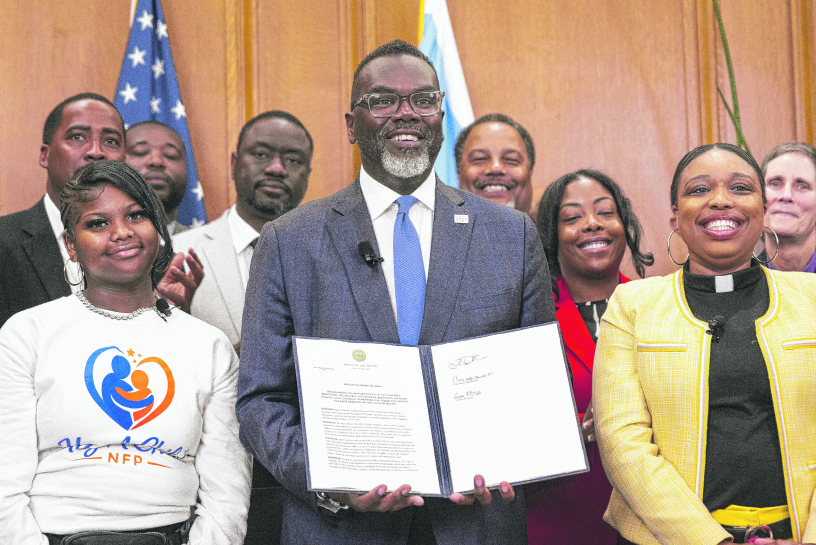
Mayor Brandon Johnson signs an executive order Thursday at City Hall creating a new Office of Gun Violence Reduction.
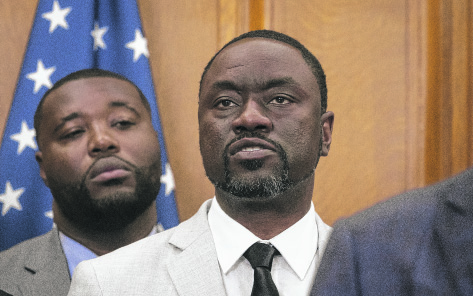
Deputy Mayor of Community Safety Emmanuel Andre speaks to reporters after Mayor Brandon Johnson signed an executive order to create an Office of Gun Violence Reduction.
Andre will serve as executive director of the new office.
ASHLEE REZIN/SUN-TIMES PHOTOS
Andre will serve as executive director of the new office.
ASHLEE REZIN/SUN-TIMES PHOTOS


Mayor Brandon Johnson issued an executive order Thursday to begin the potentially costly process of delivering on his promise to create the stand-alone city department focusing exclusively on reducing and preventing gun violence.
Two days after embracing a plan that Chicago mayors have been resisting for more than a decade, Johnson put some meat on the bone.
He established an Office of Gun Violence Reduction within the mayor’s office and outlined procedures to support the establishment of a permanent city department to coordinate and strengthen the city’s disparate efforts.
“For far too long in this city, we have not met the scale of the challenge facing our residents with the level of investment or urgency needed to transcend the systematic neglect and separation that has left lasting scars between our communities,” Johnson said during a signing ceremony in the mayor’s office.
“For decades, people have demanding more from city government and today, city government responds to those demands.”
Emmanuel Andre, deputy mayor for community safety, will serve as executive director of the new office with an aggressive set of new marching orders. They include: collecting data on gun violence and violence reduction initiatives; issuing monthly progress reports; identifying communities that have borne the brunt of gun violence and designating those hardest-hit neighborhoods as “Community Safety Priority Zones.”
Andre was further charged with coordinating “comprehensive place based investment and interventions tailored to the unique needs” of each of those communities.
Johnson’s executive order also establishes a 17-member Gun Violence Reduction Advisory Council with a mix of mental health professionals, religious and community leaders, representatives from philanthropic organizations and community violence intervention organizations.
Nine of the 17 members must come from “neighborhoods disproportionately impacted by gun violence,” the order states.
The decision to create yet another level of City Hall bureaucracy — with at least seven employees and perhaps more — comes at a time when Chicago’s financial challenges have never been greater. The city faces a $36 billion pension crisis and a $1.3 billion shortfall.
With mayoral and aldermanic elections just eight months away, this year’s budget debate is likely to be even more contentious than the last two political stalemates that saw an emboldened City Council reject Johnson’s proposed $300 million property tax increase as well as his proposed corporate head tax.
Public Safety Committee Chair Brian Hopkins (2nd) said he does not believe Chicago needs or can afford to create more bureaucracy to combat gun violence.
“I don’t know where the funding is going to come from,” Hopkins said. “My fear is that the mayor is gonna want to fund this by reducing the police budget. And that is absolutely the wrong thing to do.”
There was no mention in the mayor’s press release of how much the new city department would cost or how the Johnson administration plans to pay for it. Chicago already spends tens of millions of dollars on social programs aimed at reducing gun violence, as well as on community violence interrupters who seek to mediate and mitigate gang-related disputes before they occur.
That’s in addition to the Chicago Police Department’s $2.1 billion budget.
Johnson acknowledged that Chicago is already spending over $150 million to combat gun violence.
“That, admittedly, is not enough,” he said.
The mayor added that victims of gun violence are “overwhelmingly young black boys and men” between the ages of 10 and 24. Young black girls are also increasingly becoming targets.
“If ever there was a time for us to solely focus on a particular group that’s most likely to experience the violence that comes with trauma, this is that moment,” he said.
Rev. Ciera Bates-Chamberlain, executive director of Live Free Illinois, said she has “fought for this moment” since homicides soared past 800 during Rahm Emanuel’s administration.
“Chicago is the greatest city in the world. But for far too many neighborhoods, the shadow of gun violence has lingered for generations.
It is time for our infrastructure to reflect the urgency of this crisis,” she said. Addressing the extra level of bureaucracy new effort creates, Bates-Chamberlain said, “You cannot put a price tag on life, but you can certainly put a price tag on death.”
For the first three years of his administration, Johnson joined Emanuel and former Mayor Lori Lightfoot in resisting pressure to create added bureaucracy.
But the mayor apparently changed his mind after a Juneteenth weekend that, as he put it, “should have been a celebration,” and was instead “disrupted by heartbreaking acts of gun violence” that left eight people dead and 40 others wounded.
The outbreak of summer violence interrupted what has become his primary pitch to Chicago voters: Historic reductions in crime and violence that saw Chicago homicides rates plunge to their lowest point in 60 years in 2025. Other major cities have seen similar reductions since the historic highs recorded during the pandemic.